What Is Chinese Tie Dye? A Beginner Guide to Dali Bai Indigo Craft
Chinese tie dye is a traditional resist-dyeing craft that uses folding, tying, stitching, and indigo dye to create blue-and-white textile patterns.
One of its best-known forms is Dali Bai tie dye from Yunnan, a quiet craft shaped by cloth, thread, dye, and handwork.
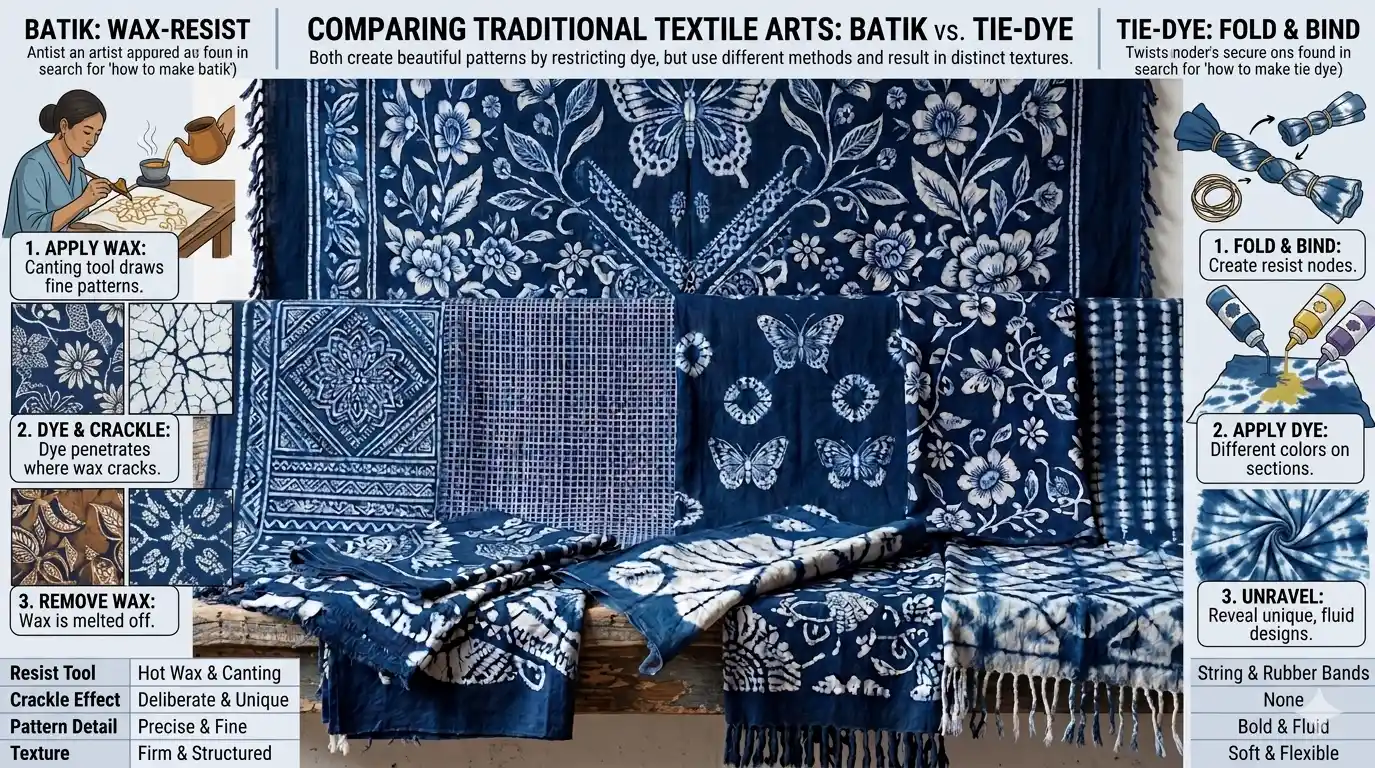
Chinese Tie Dye Is a Quiet Craft of Folding, Binding, and Indigo
Traditional Dali Bai tie dye is not built around bright rainbow spirals. Its visual world is usually quieter: indigo blue, white resist patterns, soft edges, repeated motifs, and fabric that still shows the maker’s hand.
The craft begins before the dye touches the cloth. A maker folds, ties, or stitches the fabric so selected areas resist the indigo. After repeated dyeing and drying, the tied sections are opened and the hidden pattern appears.
Where Does Chinese Tie Dye Come From?
Chinese tie dye mainly comes from southwestern China, especially Yunnan, Guizhou, and Sichuan, where many ethnic minority groups have preserved traditional textile crafts.
The most famous origin is Dali in Yunnan Province, home to the Bai ethnic group. In this region, tie dye appears in household textiles, clothing, decorative cloth, and cultural memory.
Dali Bai tie dye is especially associated with Zhoucheng Village near Xizhou, where visitors can still find workshops, textile shops, and hands-on dyeing experiences.
Guizhou is strongly connected with embroidery, batik, dyeing, and ethnic costume traditions. It links Chinese tie dye to a broader handmade textile culture.
Sichuan also appears in discussions of local textile and dyeing traditions across southwestern China.
How Dali Bai Tie Dye Is Made
Dali Bai tie dye is a slow handmade process. The fabric is folded, tied, stitched, dyed with indigo, dried, and opened to reveal the pattern.
Fold the fabric
The cloth is folded into planned shapes before tying or stitching.
Tie or stitch the pattern
Threads, knots, or stitched sections block dye from reaching some areas.
Dye with indigo
The fabric is dipped repeatedly into indigo dye to build a deeper blue.
Dry and open
The tied sections are opened to reveal blue-and-white patterns.
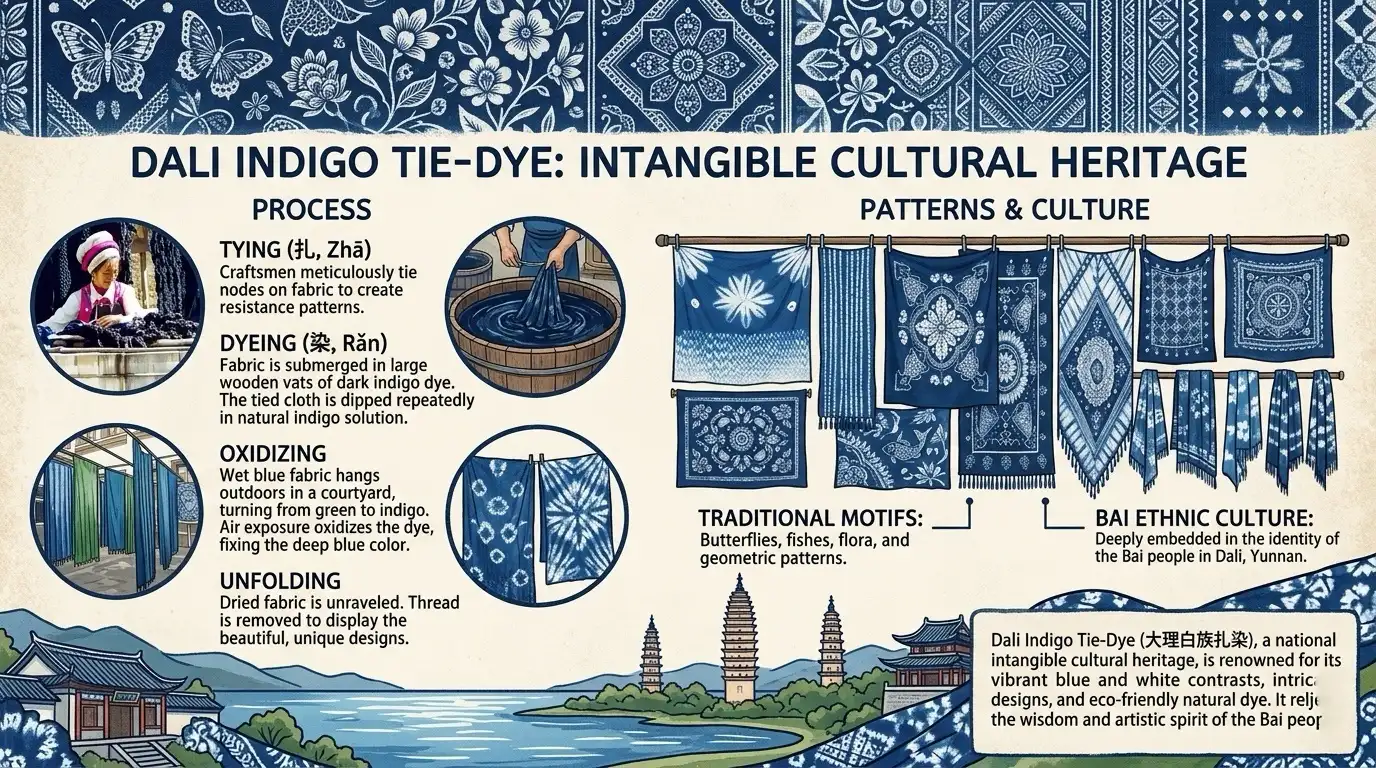
Bai Ethnic Tie Dye: Dali, Yunnan
Bai tie dye is the most well-known form of Chinese tie dye. It mainly uses indigo blue and white patterns, often with soft cloud-like edges and quiet geometric rhythm.
The most famous place to experience this craft is Zhoucheng Village in Dali, often described as a hometown of tie dye. Visitors can watch local artisans create textiles by hand and try simple dyeing workshops.
Compared with modern tie dye, Dali Bai tie dye usually feels calmer and more architectural. The beauty is not in loud color contrast, but in the way white spaces emerge from a field of indigo blue.
Bai, Yi, Buyi, and Miao Textile Styles
Chinese tie dye varies by ethnic group. Bai, Yi, Buyi, and Miao communities each developed their own textile language, pattern preferences, and symbolic meanings.
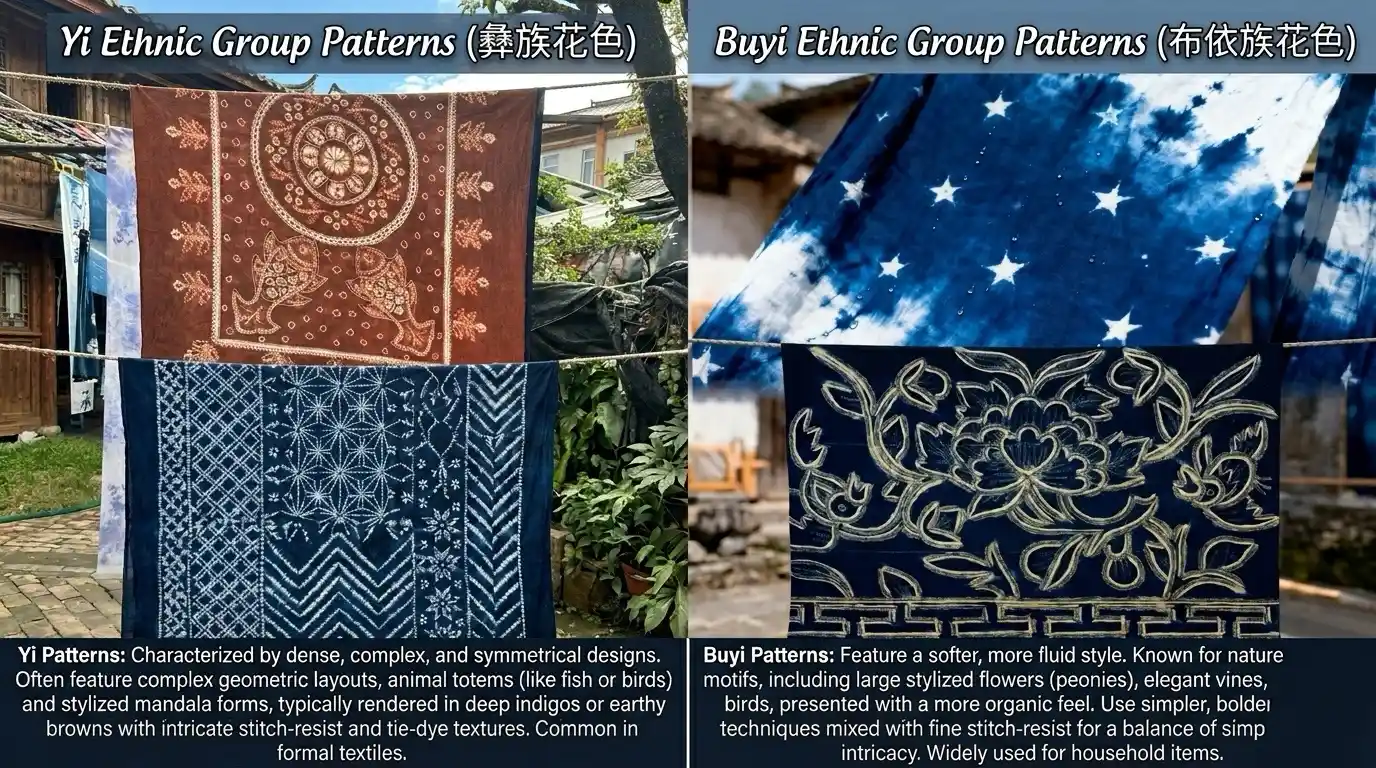
Stronger contrast and symbolic motifs
Yi textile patterns may show sharper contrast, natural elements, and geometric structure.
Stitching, folding, and occasion-based design
Buyi styles often emphasize stitching and folding, with decorative patterns used in important occasions.
A connected textile world
Miao textile culture is more widely known for embroidery and batik, but it belongs to the same wider world of ethnic textile art. Learn more about Miao embroidery.
Chinese Tie Dye vs Batik
Chinese tie dye and batik are both resist-dyeing crafts, but they are not the same technique. Tie dye uses folded, tied, or stitched fabric to resist dye. Batik uses wax to control dye placement.
Chinese tie dye
The pattern comes from folded, tied, or stitched cloth. The final effect is often softer, with flowing edges and handmade variation.
Batik
The pattern comes from wax-resist drawing. The final effect is often more controlled, with wax lines, motif outlines, and sometimes crackle textures.
For a beginner-friendly breakdown, read our full comparison of batik and tie dye. If you want to understand wax-resist craft, see how traditional batik is made in China.
Why This Blue-and-White Craft Still Matters
Chinese tie dye is not only decorative. It carries cultural meaning through motifs, materials, and the slow rhythm of handmade work.
Flowers may suggest beauty and prosperity. Circle patterns can suggest harmony and unity. Natural motifs often reflect the relationship between people, landscape, and local tradition.
For broader intangible cultural heritage context, you can explore the UNESCO intangible cultural heritage portal.
Experience Chinese Tie Dye in Real Life
Today, Chinese tie dye is not only a craft but also a cultural experience. In places like Zhoucheng Village in Dali, visitors can watch artisans create tie dye by hand, then try a simple dyeing project themselves.
A workshop usually lets visitors see the fabric being folded, tied, stitched, dyed, dried, and opened. The final reveal is the small theatre of the craft: a folded cloth becomes a blue-and-white pattern with its own rhythm.
This is also why Chinese tie dye can make a meaningful gift. It is not only a decorative object. It carries handwork, place, and cultural memory.
See artisans at work
Observe folding, tying, stitching, dyeing, drying, and pattern opening.
Make a blue-and-white textile
Many workshops offer beginner-friendly tie dye experiences.
Choose something with a story
Handmade tie dye combines craft value, cultural meaning, and unique design.
Related Chinese Craft and Textile Guides
These guides connect this Dali Bai tie dye article to your wider traditional craft, batik, natural dye, and cultural gift cluster.
FAQ: Chinese Tie Dye and Dali Bai Tie Dye
What is Chinese tie dye?
Chinese tie dye is a traditional textile-dyeing technique using folding, tying, stitching, and indigo dye, mainly practiced by ethnic groups in southwestern China.
Is Chinese tie dye the same as regular tie dye?
Not exactly. Chinese tie dye focuses more on natural dye, cultural symbolism, and traditional craftsmanship, while modern DIY tie dye often focuses on bright colors and casual patterns.
Where does Chinese tie dye come from?
It mainly comes from Yunnan, Guizhou, and Sichuan, especially among Bai, Yi, Buyi, and Miao ethnic groups.
Where can I see authentic Chinese tie dye?
One of the best-known places is Zhoucheng Village in Dali, Yunnan, often associated with Dali Bai tie dye workshops.
Is Dali Bai tie dye usually blue and white?
Yes. Dali Bai tie dye is strongly associated with indigo blue and white patterns, although designs, motifs, and fabric forms can vary.