What Is Chinese Paper Cutting? History, Meaning, and Traditional Uses
Chinese paper cutting is a traditional folk art in which paper is cut or carved into connected patterns, figures, symbols, and scenes. Known in Chinese as jianzhi (剪纸), it has long been part of homes, festivals, weddings, textile work, ceremonies, and community life.
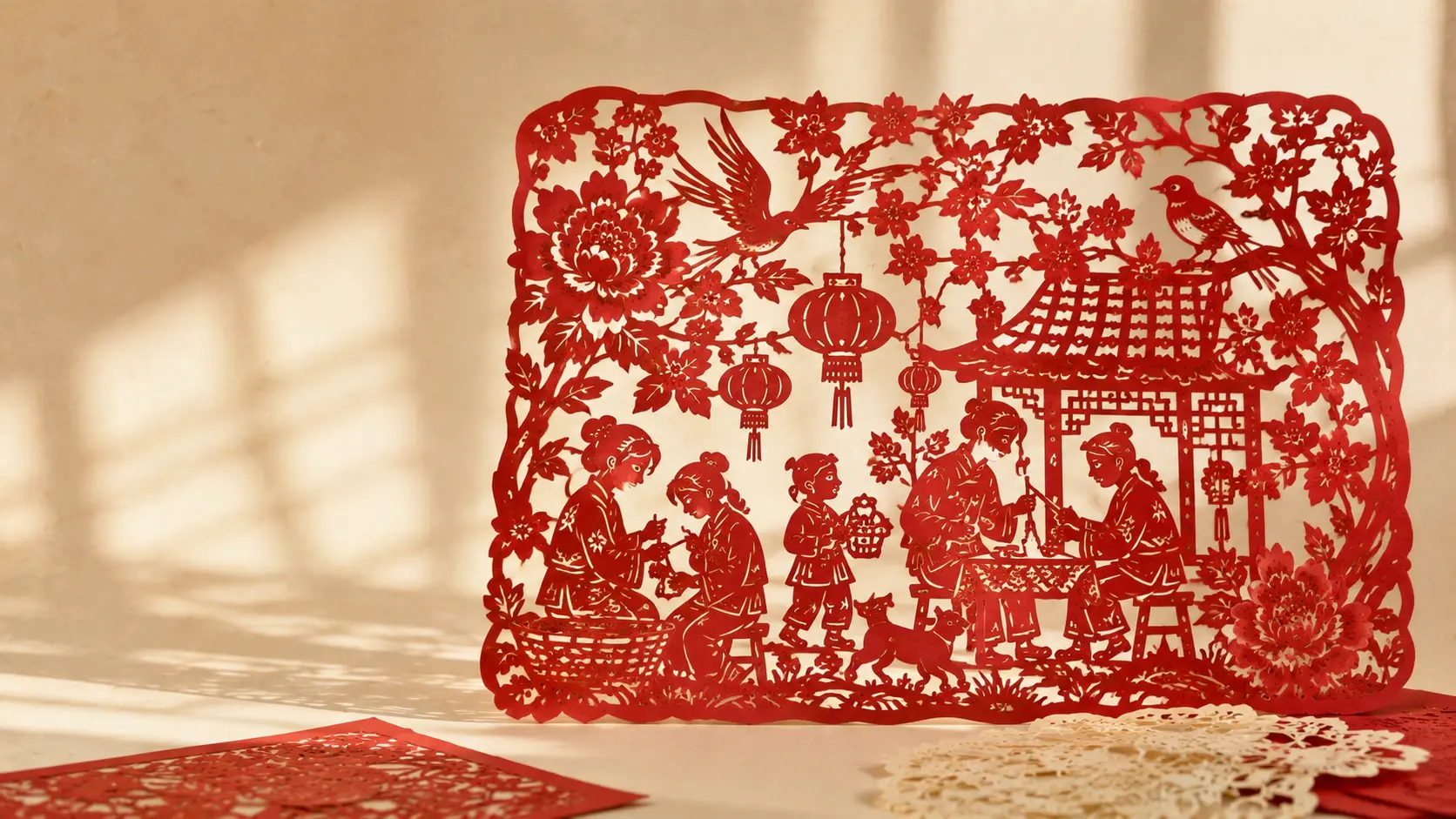
Chinese paper cutting, or jianzhi, is a Chinese folk art made by cutting or carving paper into connected designs. Traditional paper cuts have been used on windows, doors, walls, ceilings, furniture, gifts, ceremonial objects, and embroidery patterns.
They are especially associated with Chinese New Year, weddings, birthdays, household decoration, prayers, and family celebrations. UNESCO inscribed Chinese paper-cut on the Representative List of the Intangible Cultural Heritage of Humanity in 2009.
What Is Chinese Paper Cutting Called?
The most common Chinese name is 剪纸, pronounced jiǎnzhǐ. The two characters literally mean “cut paper.”
English-language sources use several related expressions. They overlap, but they do not always describe exactly the same working method.
What Defines Chinese Paper Cutting as an Art Form?
A paper cut is not simply a drawing placed on paper. The artist creates the image by removing paper while keeping the remaining structure readable and physically connected.
The design must stay connected
A flower, animal, character, or human figure must remain intact after the surrounding paper is removed.
Empty areas shape the image
Light, contrast, movement, and rhythm come from the relationship between solid paper and cut-out space.
The image often carries a purpose
Many works are connected with a festival, family event, textile pattern, prayer, local custom, or household decoration.
For a closer look at bridges, negative space, folds, pattern categories, and printable structures, continue to the Chinese Paper Cutting Patterns guide.
A Brief History of Chinese Paper Cutting
The exact beginning of Chinese paper cutting is difficult to establish because paper is fragile and everyday decorations were not usually preserved as valuable objects.
Cut decoration existed in other thin materials
Leaves, fabric, leather, foil, and similar surfaces could be pierced or cut into decorative forms before paper became widely available.
Early surviving paper cuts
Some of the earliest known excavated Chinese paper cuts were found in Turpan in present-day Xinjiang and are dated to the Southern and Northern Dynasties, 420–581.
Layered, painted paper flowers survive
British Museum objects from Dunhuang include flowers made from multiple superimposed paper-cut layers that were painted and pasted together.
Domestic and decorative uses expanded
Paper cutting became increasingly connected with household decoration, textile patterns, religious activities, ceremonies, and seasonal customs.
UNESCO inscription
Chinese paper-cut was inscribed on UNESCO’s Representative List of the Intangible Cultural Heritage of Humanity.
A living tradition, not one frozen style
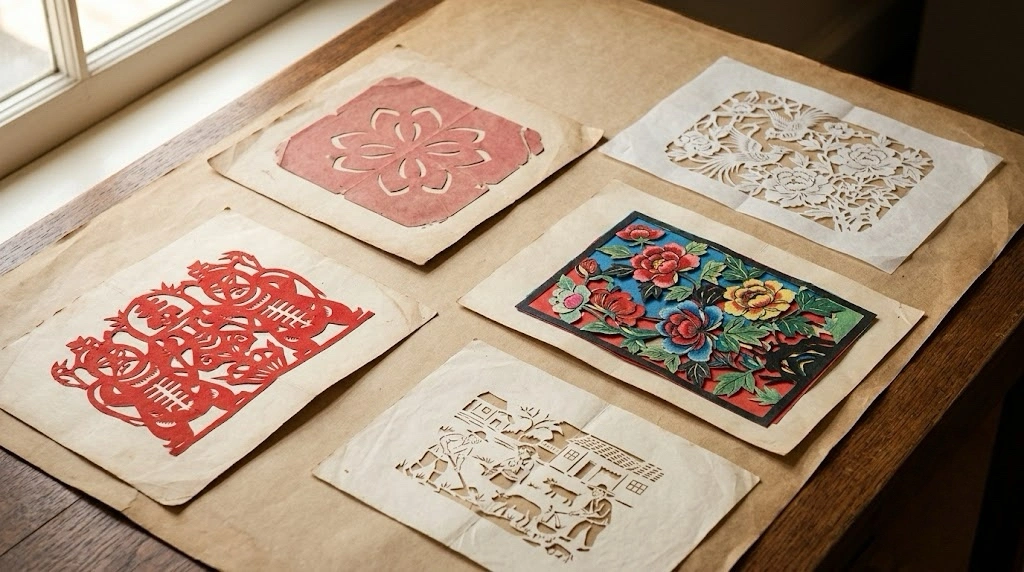
Chinese paper cutting developed across many regions and communities. Some traditions favor bold silhouettes, while others use fine knife-cut lines, painted color, dyed paper, or layered compositions.
The historical record is therefore better understood as a network of living local traditions than as one single invention followed by one standard style.
A Tradition Passed Through Families and Communities
Chinese paper cutting was often learned informally. In many communities, children watched older relatives prepare decorations, textile patterns, wedding designs, and seasonal paper cuts.
UNESCO describes the practice as historically transmitted over long periods within families and notes its strong connection with everyday and rural life. The most skilled makers could gain respect within their communities.
A design could preserve a family preference, local story, regional cutting method, wedding custom, embroidery pattern, or ceremonial practice. This is one reason Chinese paper cutting never became a single fixed national style.
What Does Chinese Paper Cutting Mean?
There is no universal meaning shared by every paper cut. Meaning is built through subject, language, pairing, occasion, placement, regional custom, and the maker’s own intention.
An animal, plant, or object may be chosen because its Chinese name sounds like a word connected with abundance, good fortune, happiness, or longevity.
A bird beside a flower can communicate something different from the same bird shown alone. Meaning often comes from relationships between motifs.
The same subject can take on a different role at Chinese New Year, a wedding, a birthday, a harvest celebration, or a household ritual.
Scenes of farming, cooking, children, animals, work, and celebration can preserve ordinary experiences beyond formal written history.
Often connected with abundance or surplus through sound-based association.
Commonly associated with beauty, richness, flourishing life, or prestige.
The character 囍 is closely associated with weddings and marriage celebrations.
Connected with birth years, family identity, seasonal decoration, and Chinese New Year.
Why Is Red Paper So Common?
Red is strongly associated with happiness, vitality, celebration, and good fortune in many Chinese settings. It also creates strong contrast against pale windows, white walls, doors, lanterns, and gift packaging.
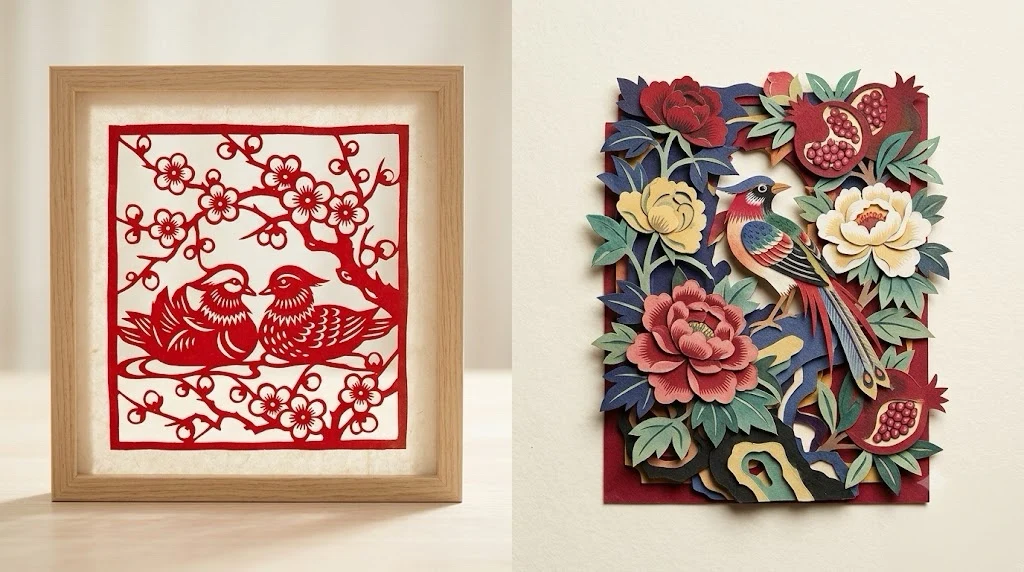
Red is important, but it is not the only traditional choice. Chinese paper cuts may also be black, white, gold, dyed, painted, layered, or multicolored.
For practical color combinations and modern applications, visit Chinese Paper Cutting Ideas.
Traditional Uses of Chinese Paper Cutting
Chinese paper cuts have served decorative, ceremonial, practical, and social purposes. Their scale and structure often reflect where they were intended to be placed.
Window flowers, or chuanghua, use light passing through the cut areas to make the pattern visible from both inside and outside.
Paper cuts may appear on windows, doors, walls, lanterns, cabinets, and gift packaging to renew the household and express hopes for the year ahead.
Paired figures, flowers, birds, and the Double Happiness character may decorate rooms, windows, mirrors, furniture, and ceremonial objects.
Peaches, cranes, deer, pine trees, and longevity characters may be used according to family custom and the intended blessing.
Uses may include prayers, seasonal rites, protective customs, funerary activities, temple practices, and agricultural ceremonies, depending on the region.
Paper cuts could guide embroidery, shoes, clothing, pillows, household textiles, decorative borders, and fabric patterns.
Designs could be made for walls, ceilings, beds, cupboards, lamps, containers, furniture, and household tools.
Narrative scenes can preserve local legends, opera subjects, village work, family life, celebrations, and ordinary social memory.
The separate Chinese New Year Paper Cutting guide will explore festival decorations, meanings, and beginner craft ideas in greater detail.
Why Chinese Paper Cutting Does Not Have One Single Style
Chinese paper cutting is an umbrella term for many regional, community, and family traditions. UNESCO notes that motifs vary according to region and purpose, and that fine, delicate motifs are especially associated with some southern traditions.
- Line thickness and density
- Scissor or knife-based cutting
- Monochrome or multicolored work
- Symmetrical or freehand composition
- Local stories and ceremonial uses
- Bold silhouettes or fine detail
Detailed regional comparisons and pattern categories belong in the Chinese Paper Cutting Patterns guide.
Is Chinese Paper Cutting Always Handmade?
Traditional Chinese paper cutting is handmade with scissors, knives, or engraving tools. Modern makers may also use tracing paper, printed guides, digital drawing, cutting machines, laser cutting, and downloadable templates.
Technology changes the production process, but it does not automatically decide whether a work has cultural value. Clear labeling is more important. A user should be able to understand whether an item is handmade, machine cut, digitally illustrated, printed, laser cut, or based on a traditional motif.
A printable template can help a beginner study connected structure and negative space, but it should not be described as identical to a hand-cut work made by an experienced traditional artist.
Chinese Paper Cutting Today
Chinese paper cutting continues to change rather than remaining sealed inside a museum display.
Contemporary artists preserve inherited techniques, create new subjects, work at larger scales, and combine hand cutting with layered color or digital tools.
Schools, museums, workshops, and heritage programs use paper cutting to teach visual storytelling, symmetry, festivals, zodiac culture, and folk art.
Paper-cut imagery now appears in greeting cards, packaging, illustration, fashion, interiors, public art, and digital media.
Reading Chinese Paper Cuts Responsibly
Look for information about the artist, region, community, occasion, collection, and intended use.
A motif may carry several meanings depending on language, pairing, placement, and local tradition.
A contemporary printable, machine-cut decoration, and handmade folk artwork may share imagery, but they are not the same object or process.
Chinese Paper Cutting Guides and Resources
FAQ About Chinese Paper Cutting
What is Chinese paper cutting?
Chinese paper cutting is a folk art made by cutting or carving paper into decorative and symbolic designs. It has been used in homes, festivals, weddings, ceremonies, textiles, education, and contemporary art.
What is Chinese paper cutting called in Chinese?
It is commonly called jianzhi, written as 剪纸, meaning “cut paper.”
When did Chinese paper cutting begin?
Its exact beginning is difficult to establish because paper is fragile. Some of the earliest known excavated examples were found in Turpan and date to the Southern and Northern Dynasties, 420–581.
What does Chinese paper cutting mean?
Meaning depends on the subject, wordplay, occasion, placement, region, surrounding motifs, and the maker’s intention. Paper cuts may express abundance, marriage, longevity, protection, seasonal renewal, or scenes of everyday life.
What is Chinese paper cutting used for?
It has been used for window decorations, Chinese New Year, weddings, birthdays, ceremonies, embroidery patterns, household decoration, teaching, and artistic display.
Is Chinese paper cutting the same as origami?
No. Origami creates form mainly by folding paper. Chinese paper cutting creates designs by removing paper with scissors or knives, although folding may be used to create symmetry.
Is Chinese paper cutting only used during Chinese New Year?
No. Chinese New Year is one important setting, but paper cuts are also connected with weddings, birthdays, household decoration, religious activities, textile work, family life, regional festivals, and modern art.
Are all Chinese paper cuts red?
No. Red is common because of its festive associations, but Chinese paper cuts may also be black, white, gold, dyed, painted, layered, or multicolored.